Ashleigh Brown, the RSPCA, and a Charity Conflict the League Can’t Ignore
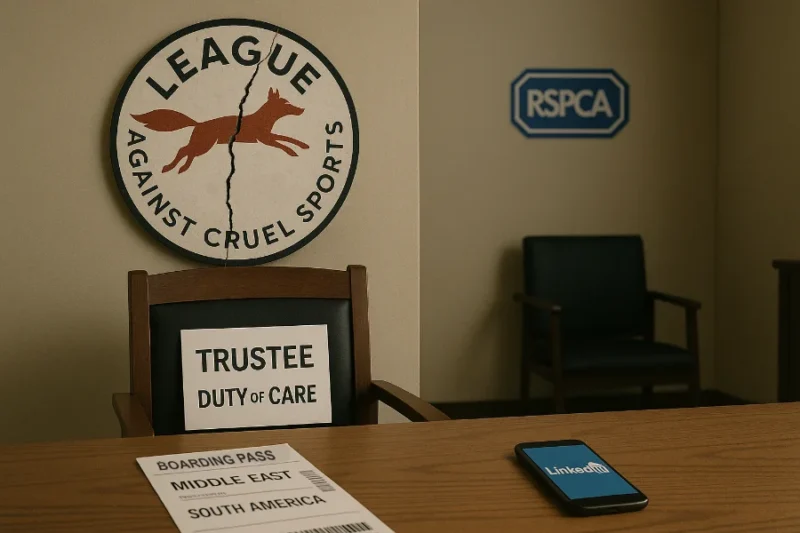
What happens when someone sits at the heart of two rival charities — one as a paid professional, the other as a supposedly impartial trustee? That’s the uncomfortable question posed by Ashleigh Fiona Brown’s dual roles at the RSPCA and the League Against Cruel Sports.
Since December 2024, Brown has been employed by the RSPCA — the UK’s largest and best-funded animal welfare organisation. At the same time, she remains a trustee of the League Against Cruel Sports, a smaller, more politically focused charity campaigning against hunting and wildlife persecution. Both organisations appeal to the same public for support and influence, but they are not partners. They are, in many respects, competitors — especially when it comes to donors, media attention, and political traction.
This is not a grey area. It’s a textbook conflict of interest.
The Charity Commission’s guidance The Essential Trustee makes the obligation clear. A trustee must “act in your charity’s best interests” and “avoid putting yourself in a position where your duty to your charity conflicts with your personal interests or loyalty to any other person or body” (Section 6). Trustees are also expected to give “enough time, thought and energy” to the role — known as the duty of care (Section 8). That includes preparing for and actively participating in meetings, especially during times of crisis.
Can Brown truly claim to meet these standards?
In Summer 2023, she took a year-long sabbatical, travelling through the Middle East and South America. She returned only in May or June 2024. During this time, she remained a trustee of the League. But given the length and nature of her sabbatical, it is hard to see how she could have given the role the time, attention and active engagement it demands. The Charity Commission describes this as a trustee’s “duty of care” — a standard that would be difficult to meet while travelling for an extended period across multiple continents. The responsible action would have been to step down.
Instead, Brown’s tenure has coincided with the League’s most turbulent period in recent memory. When she joined as a trustee in 2020, the League still retained credibility. That same year, a now-infamous leaked webinar caught Mark Hankinson — then Director of the Master of Foxhounds Association — describing the League’s investigations team as “a force to be reckoned with.” Just two years later, the League made that team redundant. According to Brown’s own LinkedIn profile, she has been involved in “charity governance” and “strategic direction” at the League — suggesting she supported this shift.
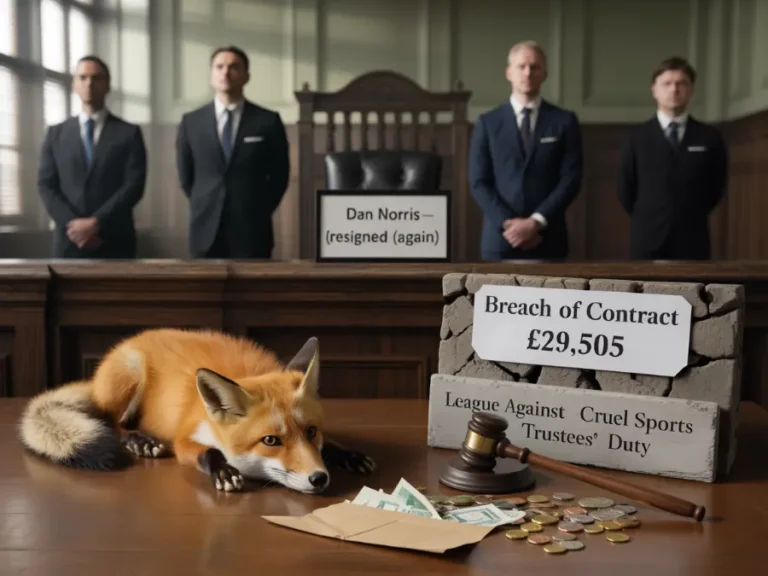
Since then, the League’s authority in the sector has collapsed. In place of credible investigations and professional campaigning, it now relies on staff in fox costumes prancing around shopping centres for PR stunts. Last year alone, the League saw a 25% staff turnover — a clear indicator of dysfunction. Its former CEO, Andy Knott, left suddenly and without explanation, prompting serious media scrutiny.
Perhaps most concerning of all, the League’s members and donors were misled about the reappointment of Chair Dan Norris — first brought back quietly after an earlier unexplained resignation, and later forced out again following his arrest on suspicion of serious criminal offences. Trustees, including Brown, were complicit in keeping members in the dark.
What’s more, Brown appears to have shown poor judgement in handling confidential League information. According to Private Eye (Issue No. 1638, 6 December 2024), League trustee Astrid Clifford confirmed that Dan Norris’s political adviser, Alex Mayer, was “copied into email communications and privy to some information regarding the League, some of which could be considered confidential.” Internal League figures — including acting CEO Chris Luffingham — were instructed to share sensitive material with Mayer, who had no formal role within the charity. This lapse happened under the watch of the Board, of which Brown is a long-standing member. That such an arrangement was tolerated suggests a worrying disregard for basic charity safeguards.
Throughout this decline, Brown has been silent. There is no evidence that she challenged poor decisions or demanded transparency. And while the League’s reputation sinks, Brown’s LinkedIn profile reflects an altogether different priority: career building. She places her trusteeship not under volunteering, but as a formal entry under “Experience,” alongside her professional roles. It is listed as a governance credential, not a selfless contribution.
Trusteeship is not a badge. It is not a networking tool. It is a serious legal and moral responsibility to act independently, with integrity, and in service of the organisation — not one’s own ambitions, or those of a rival employer.
Brown’s continued presence on the League board compromises both her and the charity. It undermines the League’s credibility, blurs its independence, and invites public mistrust. Her dual role may still be technically lawful. But it is not ethical, not responsible — and not sustainable.
Her position is untenable. Ashleigh Brown should resign.