The Risks of Applause-Led Charity Governance
by Charlotte Benson, Charity Governance Advisor
The League Against Cruel Sports has announced that its Chief Executive, Emma Slawinski, has been named Best Animal Welfare Charity CEO 2025 (UK) at the Female CEO of the Year Awards, run by CEO Monthly.
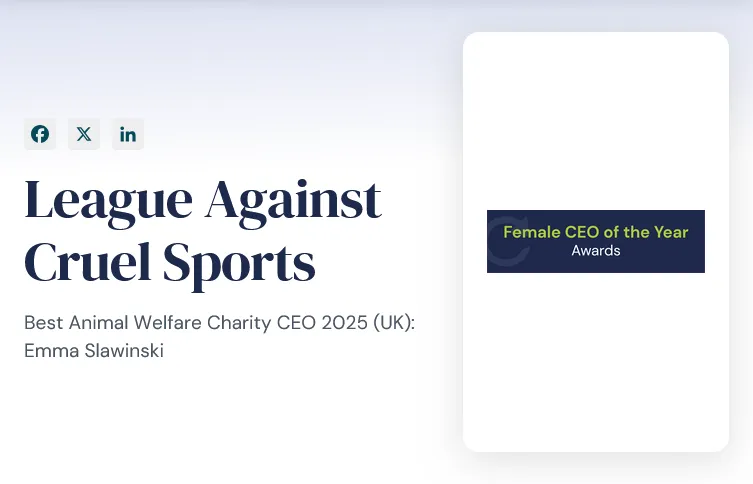
In promoting the announcement on social media, the League described the award as “independent recognition” of Emma Slawinski’s leadership, vision, and commitment to ending cruelty in sport. The League’s Chair echoed this message publicly, praising the Chief Executive and expressing organisational pride.
Awards and professional recognition can have a legitimate place in public life. But when a charity actively promotes such accolades to supporters — particularly without context, explanation, or detail — it is reasonable to ask whether this serves transparency, or whether it risks misleading impressions that ultimately damage trust.
This article does not question Emma Slawinski’s integrity, competence, or commitment to animal welfare. It examines the award itself, the awarding body, and a wider organisational communications pattern that carries real consequences — for donor confidence, organisational credibility, and for the Chief Executive placed at the centre of such messaging.
The awarding organisation
CEO Monthly is a digital publication owned by AI Global Media, a company specialising in business-to-business content across multiple sectors. According to its own published material, AI Global Media operates a portfolio of digital magazines, newsletters, and awards programmes aimed at a global professional audience.
CEO Monthly states that award recipients are featured on its website for a minimum of 12 months. It also notes that additional promotional opportunities are available, including trophies, certificates, logos, and placement in awards supplements.
These statements are publicly available and describe a commercial model in which awards operate, at least in part, as vehicles for visibility and brand promotion.
Transparency and assessment
The public-facing page announcing Emma Slawinski’s award lists her name, organisation, and category title. It does not publicly set out:
- the criteria used to assess nominees
- any specific achievements relied upon
- the identity of a judging panel
- the number or identity of other nominees considered
This absence of information does not imply impropriety. However, it leaves supporters unable to assess what the award actually represents, or how it distinguishes the recipient from others working in animal welfare.
When charities present awards as “independent recognition”, a degree of transparency around process and evaluation is often expected by donors and sector observers — not as a technical requirement, but as a matter of credibility.
Timing and tenure
Emma Slawinski began her role as Chief Executive of the League Against Cruel Sports in mid-March 2025. CEO Monthly states that entries for the Female CEO of the Year Awards 2025 opened on 4 August 2025 and closed on 29 September 2025.
The nomination therefore occurred after only a few months in post. This is not, in itself, a criticism. However, it does raise reasonable questions about what outcomes, organisational changes, or demonstrable impacts were capable of being assessed within that timeframe, and on what comparative basis.
Those questions matter because the League chose to promote the award publicly as evidence of leadership excellence, without explaining what had been evaluated or measured.
An established communications pattern
The League’s approach to presenting achievements did not begin with the current Chief Executive. In previous reporting, Wildlife Betrayed has highlighted instances where the organisation’s public messaging risked overstating its role or the significance of outcomes.
Most recently, in an article relating to cub hunting, the League referred to the work of “our investigators”, despite the activity in question having been carried out by independent hunt saboteurs and monitors. While the League may legitimately campaign on the basis of such work, describing it in this way created a risk that supporters would attribute frontline activity directly to the charity when that was not the case.
That example is relevant here not because it proves intent to mislead, but because it illustrates a recurring communications tendency: credit and recognition being framed in ways that may exceed the organisation’s direct role or the underlying facts.
Seen in that context, the promotion of the CEO Monthly award — presented without explanation of criteria, competition, or assessment — appears less an isolated lapse and more part of a broader pattern in which reputational claims are made confidently, while qualifying detail is omitted.
Emma Slawinski, who joined the League only recently, did not create this pattern. She appears to be operating within it. No suggestion is made that this approach breaches charity law; the concern is whether it best serves transparency, donor understanding, and long-term trust.
Why this matters — to donors, wildlife, and leadership
The charitable sector now operates in an environment saturated with awards, endorsements, and branded recognition. Some are genuinely competitive and meaningful; others function primarily as promotional tools.
Supporters who donate to protect wildlife are entitled to assume that:
- achievements promoted by charities reflect demonstrable impact
- leadership recognition is grounded in evidence, not optics
- donor funds are directed toward outcomes, not image management
When charities promote awards or claim achievements without context, they risk undermining all three assumptions. More importantly, they risk damaging the credibility of their own leaders by placing them at the centre of claims that cannot easily be substantiated.
That is the real cost of this approach. It does not protect the organisation’s reputation; it exposes it. And it does not strengthen leadership; it leaves it vulnerable to justified scepticism.
Trustee oversight and fiduciary responsibility
Charity trustees are ultimately responsible for ensuring that public communications accurately reflect the organisation’s activities and achievements. Under their fiduciary duty, trustees must act in the best interests of the charity and its beneficiaries, safeguard donor confidence, and maintain organisational credibility. Where awards, recognition, or other public claims are promoted, trustees should consider whether the information provided allows supporters to make informed judgements, and whether communications practices are consistent with transparency and accountability obligations. Oversight in these areas is an essential component of sound governance and long-term public trust.
Culture, not individuals
This is not an argument against Emma Slawinski. It is an argument against a culture in which branding substitutes for accountability, and recognition is allowed to run ahead of demonstrable results.
If the League Against Cruel Sports genuinely wishes to change course, it should consider whether donor confidence is better served by careful, transparent reporting of what it does — and does not — do, rather than by celebratory announcements that invite scrutiny they cannot withstand.
Donations given to protect wildlife should advance that mission directly. When communications instead prioritise reputation-building, both wildlife and public trust are placed at risk.
In the charitable sector, credibility is not awarded. It is earned — slowly, visibly, and through honesty about where credit is due.